Family Dentistry
When Should My Child First See a Dentist? A Riverside Parent's Complete Guide
Most parents assume a child's first dental visit should happen when all their baby teeth have arrived — or when something looks wrong. In fact, the Australian Dental Association recommends a first visit around 18 months to two years of age. At Riverside No Gap Dental, we see children from this age because early visits prevent problems, build positive associations with dental care, and can be fully bulk-billed under Medicare for eligible families.
Why Baby Teeth Matter More Than You Think
Baby teeth are not placeholders. They allow your child to chew a varied and nutritious diet, develop clear speech, and smile with confidence during their formative years. Crucially, they hold the correct space in the jaw for the permanent teeth developing directly beneath them — and losing a baby tooth early through decay or infection can cause the adjacent teeth to drift, creating crowding and misalignment problems that require orthodontic treatment later.
Baby bottle decay — caused by putting a child to sleep with a bottle of milk, formula or juice — is one of the most common preventable dental problems we see. It can affect multiple teeth rapidly and cause significant pain and infection in children as young as two or three years old. Early dental visits give us the opportunity to identify risk factors and guide parents on feeding habits before problems develop.
What Happens at a Toddler's First Dental Visit
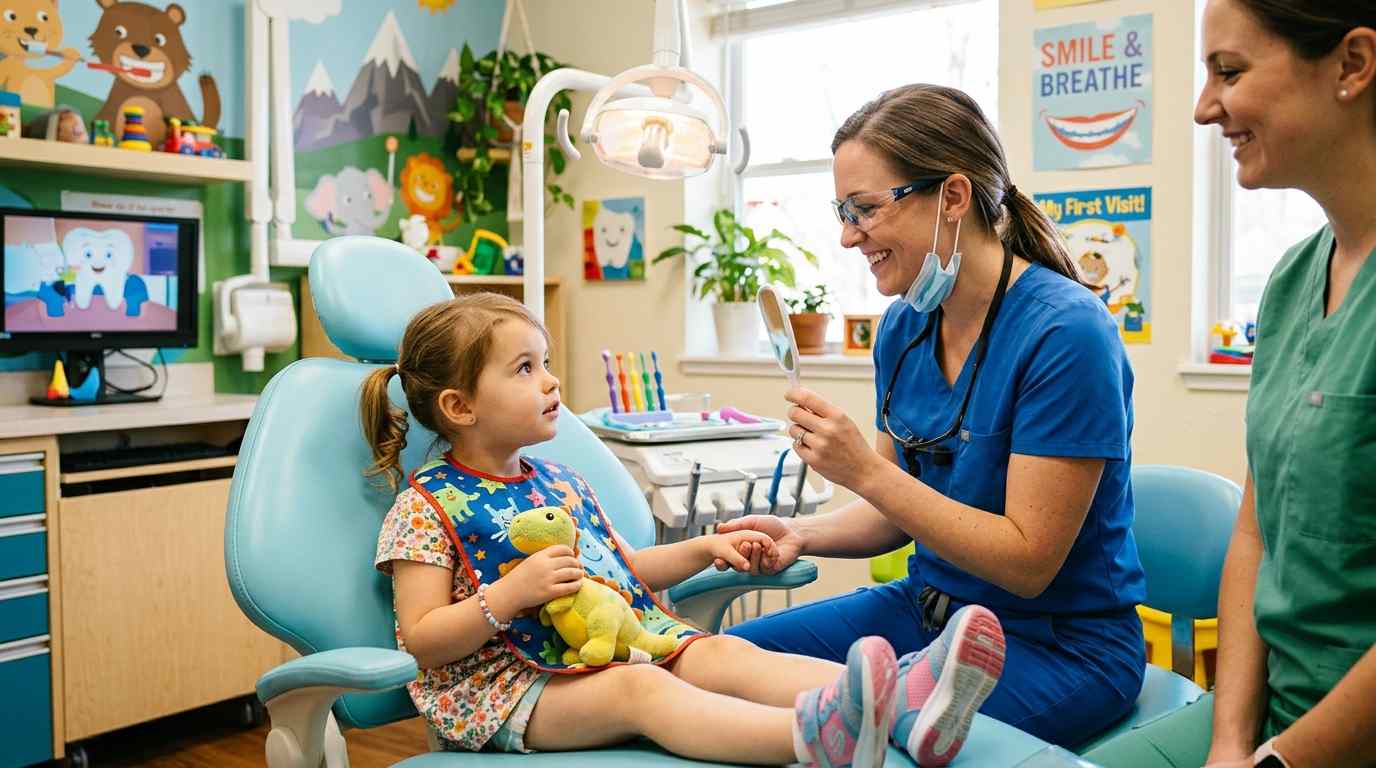
There is nothing stressful about a first dental visit at our Riverside practice — for parent or child. We make it exploratory and positive. Your child is given time to get comfortable with the environment, meet the team and investigate the chair before any examination begins. There is no rush, and there are no instruments unless your child is happy and settled.
The examination itself involves counting the teeth, checking for early signs of decay, assessing the development of the bite and jaw, and reviewing any oral habits such as dummy use or thumb sucking. We will give you practical, personalised guidance on the best toothbrush and toothpaste for your child's age, correct brushing technique, fluoride use, and which foods and drinks carry the highest decay risk.
Building a Child Who Is Not Afraid of the Dentist
Dental anxiety in adults almost always traces back to a negative early experience — or to never having been to the dentist before a problem forced the issue. Children who attend regularly from an early age, in a positive and unhurried environment, build familiarity and trust that typically lasts their entire life. This is one of the most significant gifts you can give your child's long-term health.
- ◆Talk about the dentist casually and positively in the weeks before the appointment
- ◆Avoid words like 'needle', 'hurt', 'scary' or 'it won't hurt' — all draw attention to pain
- ◆Read children's books about visiting the dentist to familiarise the idea
- ◆Play 'dentist' at home — counting teeth with a spoon and mirror is normalising
- ◆Let your child bring a favourite toy or comfort item to the appointment
- ◆Keep your own body language relaxed — children read parental anxiety very clearly
"A child who grows up comfortable at the dentist will be a healthy adult with teeth for life. That starts at 18 months — not at the first toothache."
Free Children's Dentistry Under Medicare — Up to $1,052
Eligible children aged 2 to 17 can access up to $1,052 in free dental treatment over a two-year benefit period under the Medicare Child Dental Benefits Schedule (CDBS). Eligible services include examinations, X-rays, scale and cleans, fissure sealants, fillings, extractions and root canals.
At Riverside No Gap Dental, we bulk bill all children eligible for the CDBS — meaning zero out-of-pocket cost for families for covered services. Eligibility is based on receipt of Family Tax Benefit Part A or certain other government payments. Our front desk team can check your child's eligibility over the phone when you call to book.
What to Expect as Your Child Grows
- ◆Age 18 months to 2 years: first visit, habit guidance, brushing technique
- ◆Age 3 to 5: regular six-monthly reviews, fluoride applications, positive dental habits reinforced
- ◆Age 6 to 7: first permanent molars erupt — fissure sealants can protect these teeth immediately
- ◆Age 8 to 10: monitoring of bite and jaw development, early orthodontic assessment if needed
- ◆Age 10 to 12: sports mouthguards strongly recommended as activity levels rise
- ◆Age 12 to 14: most adult teeth have erupted — a full orthodontic assessment if not already completed
Written by
Lauren Oldham
Oral Health Therapist · Riverside No Gap Dental