Cosmetic Dentistry
Composite vs Porcelain Veneers: An Honest Guide from a Riverside Dentist
Veneers can close gaps, correct chips, mask deep staining, reshape worn teeth and deliver a complete smile transformation — all without orthodontics, extractions or implants. But composite and porcelain are fundamentally different materials, and choosing the wrong one for your situation can mean spending money you did not need to spend, or compromising on a result that should have been extraordinary. Here is everything you need to know.
What Is a Dental Veneer, Exactly?
A veneer is a thin shell bonded to the front surface of a tooth to change its colour, shape, length or alignment. Veneers are typically placed on the upper front six to eight teeth — the teeth that show most prominently when you smile and speak. They are one of the most powerful tools in cosmetic dentistry because they address multiple aesthetic concerns simultaneously.
The two main types — composite resin and porcelain — achieve the same aesthetic goal through entirely different processes. Understanding the differences is essential to making the right choice for your teeth, your lifestyle and your budget.
Composite Veneers: The Single-Appointment Smile Transformation
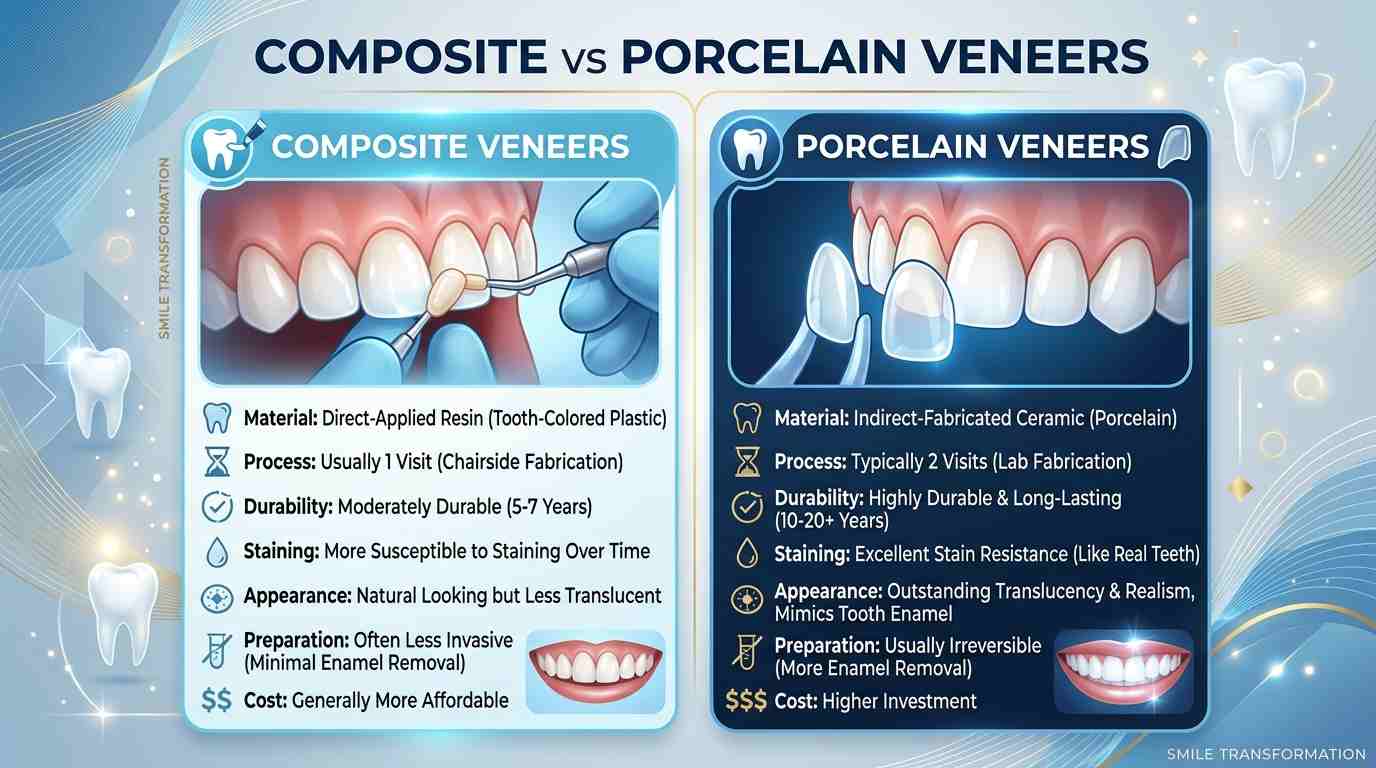
Composite veneers are sculpted directly onto your teeth during a single appointment using tooth-coloured resin — the same material used for white fillings, but applied in layers and artistically shaped to create a new smile. No laboratory is involved, no temporary veneers are needed, and you leave with your transformed smile the same day.
- ◆Completed in a single appointment — walk in, walk out with a new smile
- ◆Minimal or no tooth reduction required — often fully reversible if you change your mind
- ◆Significantly lower cost than porcelain — typically $300 to $600 per tooth
- ◆Easily repaired if a chip occurs — no need to replace the entire veneer
- ◆Ideal for younger patients, trial smiles, and patients wanting low-commitment cosmetic results
- ◆Can be colour-matched and shaped to blend seamlessly with surrounding teeth
The trade-off is durability and long-term aesthetics. Composite resin is more porous than porcelain and will gradually pick up stains from coffee, red wine and certain foods. It also has a shorter lifespan — typically five to seven years before it begins to dull, stain or chip and needs refreshing or replacing.
Porcelain Veneers: The Lifelong Investment
Porcelain veneers are ultra-thin ceramic shells precision-crafted in an Australian dental laboratory to exact specifications for your teeth. They are custom-designed to your chosen shade, shape and size and bonded permanently to your prepared tooth surface. The process typically requires two appointments — one to prepare, impress and provide temporaries, and a second to bond the final veneers once they return from the lab.
- ◆Exceptional longevity — 15 to 20 years or more with proper care
- ◆Highly stain-resistant — porcelain does not discolour over time
- ◆Unrivalled aesthetics — light transmits through porcelain similarly to natural enamel, making it nearly indistinguishable
- ◆Custom-crafted to your exact specifications in collaboration with specialist ceramists
- ◆Strong and durable once bonded to the tooth surface
- ◆Cost reflects the laboratory investment — typically $1,800 to $2,500 per tooth in Australia
The key commitment with porcelain is that some minimal tooth reduction is usually required to create room for the veneer without adding bulk. This makes porcelain a more permanent decision — once prepared, those teeth will always need coverage. This is not inherently a problem, but it is something to understand and discuss before proceeding.
"Both options are genuinely beautiful when done well. The right choice is not about which material is better — it is about which is right for your teeth, your timeline and your life."
Which One Is Right for You?
Composite veneers are typically the better choice if you want an immediate result with a lower financial commitment, if you are younger and your smile is still evolving, if you want a reversible option, or if you are planning to trial a new smile shape before committing to porcelain permanently.
Porcelain veneers are typically the better choice if you want the most durable, lifelike and long-lasting result available, if aesthetics are your absolute priority, or if you are ready to invest in a truly permanent smile transformation.
The Composite-to-Porcelain Pathway
One approach that works beautifully for many of our patients is starting with composite veneers to trial their ideal smile shape — living with the result for six to twelve months before committing to porcelain. This removes all the guesswork, lets you refine exactly what you want, and means you arrive at your porcelain treatment with total confidence about the outcome. Book a cosmetic consultation at Riverside No Gap Dental and our team will walk you through your options with no pressure and no obligation.
Written by
Dr. Jatin Chavda
Dentist — Surgical & Cosmetic · Riverside No Gap Dental